Inside Syria: The farm airstrip that's the center of the U.S. fight against ISIS
Inside Syria: The farm airstrip that's the center of the U.S. fight against ISIS
Northern Syria (CNN)The
rutted road stretches into the distance across the plains of Hasakah.
Herdsmen watch over their few dozen sheep. A scattering of oil pumps nod
lazily as they extract a few dollars of crude from deep below. Above,
the contrails left by coalition warplanes drift across the blue sky in
hazy circles.
We bump through the
mud-brick villages. Wide-eyed children stop playing marbles in the dirt
to gaze at us. Old men wearing keffiyehs, the traditional red and white
headscarf, peer suspiciously. This corner of northern Syria -- close to
the border with Iraq -- is a mix of Arab tribes and Kurds, Muslims and
Christians. It has long been neglected, despite its oil and farming, by
the Syrian regime hundreds of miles away in Damascus. But in the war
against ISIS, Hasakah is suddenly a place of interest, and especially
for the Pentagon.
Our destination is an
airstrip used for crop-spraying. From satellite images we've worked out
where it is. It would be easy to miss: just a strip of concrete that
almost sinks into the dark soil. But for all its modesty, this is the
United States' latest outpost in its deepening campaign against ISIS.
An
elderly farmer living nearby, rake-thin with a weathered brown face,
offers tea to the minibus of strange visitors, breaking off from his
duties tending sheep on behalf of a sheikh of the Shammar tribe, a
powerful Arab group that has good relations with the Kurds.
He says he has heard helicopters and other aircraft. But he's not seen anything land here. He seems bemused by the interest.
This
location has been chosen because it's just 100 miles (160 kilometers)
from ISIS frontline positions and some of its lucrative oil fields, but
well within territory held by Kurdish fighters known as the YPG. The
runway is being nearly doubled in length from about 2,300 feet to 4,330
feet (700 to 1,320 meters) -- long enough, say, to receive C130
transport planes. A small apron is also being paved.

Satellite
imagery obtained by IHS Jane's shows an airstrip in northeast Syria,
which is reportedly being used by U.S. forces, has been expanded in
recent months.
There
is no control tower, no lights, certainly no U.S. uniforms to be seen
-- just a berm of fresh earth thrown up to mark the perimeter and a
tractor chugging along as it flattens the surface of the newly extended
runway. A barrier is manned by two local men who lounge in the sunshine
smoking. But there is more security than at first appears. Minutes after
we begin filming, two men of the YPG's Asaish security force arrive in a
pickup truck and escort us away.
"It's a closed military zone," says one of them. Suicide bombings -- invariably claimed by ISIS -- are not uncommon in Hasakah.
This
"drop-and-go" strip will help the U.S. supply the Kurds and the Arab
tribes allied with them and assist the handful of U.S. Special Forces
deployed to this part of Syria.
Choosing its words carefully, the U.S. Defense Department says it has not "taken control" of any airfield in Syria.
"That
said, U.S. forces in Syria are consistently looking for ways to
increase efficiency for logistics and personnel recovery support," said a
spokesman for U.S. Central Command last month.
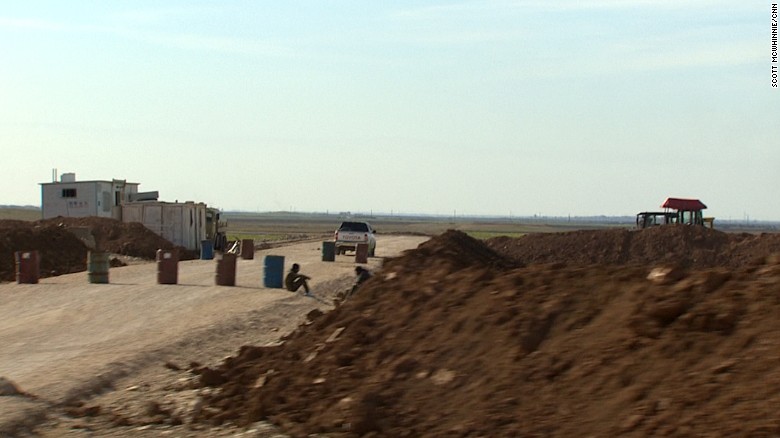
In a corner of northern Syria, a secret airfield is being built to help the U.S. military step up its war against ISIS.
The
YPG -- which can field some 25,000 men and women -- has gradually
become one of the most effective partners on the ground for the U.S.
After forcing ISIS out of the town of Kobani
on the Turkish border in 2014, with the help of intense airstrikes, its
fighters have driven ISIS out of hundreds of square miles of territory.
They now control much of the border with Turkey, hindering ISIS access
to the outside world.
There are regime
pockets in towns like Qamishli and Hasakah, redoubts blocked by street
barriers and watched over by giant posters of Syrian President Bashar
al-Assad and his late father Hafez. But the Kurds are the dominant
military force in this region, despite having little more than rifles
and pickup trucks.
The
United States has been wary of arming the YPG directly, preferring to
say that its ammunition drops are for a broader coalition of Arab
factions so as not to infuriate Turkey, which regards the YPG as a
terrorist group. Turkey has declared it will not tolerate any further
expansion of the group's presence along the border. It's a delicate
balancing act for Washington, but the presence in Kobani last weekend of
the U.S. Special Envoy to the anti-ISIS coalition, Brett McGurk,
underlines the importance of the relationship -- in a region where
effective allies have been difficult to come by.
In
part, McGurk's visit to Kobani appears to have been aimed at appeasing
the YPG, whose commanders are furious the group's representatives have
been excluded from Syrian talks in Geneva
-- at Turkey's insistence. One official even told us that unless the
YPG was admitted to the process, it would suspend co-operation on the
ground with the United States.
Calling in airstrikes ... on a tablet
For
now, the Syrian Democratic Forces (SDF) -- a makeshift alliance of
Kurds and Arab groups -- continue to close in on some ISIS oilfields and
squeeze their supply lines. They get help almost daily from coalition
airstrikes, thanks to a "Joint Operations Center."
It
is a modest setup in an abandoned apartment block on the southern
outskirts of Hasakah City. The building is pockmarked by fierce battles
fought here last August. Bullet casings still litter the hallways,
curtains flutter from shattered windows.
Three
young men sit in a small room with tablets and a radio that rests on
two packs of cigarettes. An electric heater takes the edge off the
winter chill. From here they communicate with frontline units, passing
on their coordinates and any reports of enemy movements to a coalition
command center. Then coalition bombers can be brought in.
Twenty-one-year-old
Daham Hassaki deftly scrolls from one screen to another as he plots
positions on a Google map and sends text messages to headquarters.
"Right
now this is the frontline of Hasakah," he says, opening a map that
shows the vast spaces of this part of Syria. "Our fighters there have
seen the movement of two of the enemy and so we sent this message and
their coordinates to the command center."
He
says a group of Americans and other foreigners have trained the YPG in
how to use the equipment, to ensure friendly forces are not mistakenly
targeted and that intelligence on ISIS movements is passed up the chain.
ISIS, he says, has changed the way it
operates -- deploying very small units of a half-dozen men that are
more difficult to detect.
When an
offensive is underway, the Operations Room team moves to the frontline.
Daham and his colleagues move in after a strike to see what damage has
been done. He shows us videos of their missions. They do not make for
easy viewing.

One
of dozens of locations where ISIS fighters have left behind bombs and
other IEDs as they have retreated. It will take years to defuse or
detonate the volume of ordnance scattered across Syria.
Daham
says he's not aware of any civilians killed by the strikes, but no one
can be sure. In this area, ISIS fighters have coerced whole villages of
Arabs to leave with them as they retreat. Local activists say that early
in December, a convoy leaving a tiny settlement close to the Iraqi
border was struck from the air. They claim that more than 30 civilians,
including women and children, were killed. U.S. Central Command told CNN
that "the allegation was deemed as not credible since there were no
Coalition airstrikes in the vicinity" on that day.
In
the next month or two, the Kurdish-led coalition is expected to launch
an attack on the ISIS-held town of Ash Shaddadi, a critical road
junction for the group that will not be lightly surrendered. Activists
in the area say ISIS is essentially holding the civilian population
hostage as a collective human shield, and has cut off communications
with the outside world.
The
area is targeted almost daily by airstrikes. In the countryside to the
north of the town, we heard distant thuds as ISIS defensive positions
and arms depots were targeted.
If the
SDF take Ash-Shaddadi, ISIS will have a logistical headache in
connecting Raqqa in Syria with Mosul in Iraq, its most important cities.
It is likely the next test for the new U.S. strategy of identifying and
supplying reliable local forces to battle ISIS. And an old airstrip
amid the farmsteads of northern Syria may have a new lease of life.


Comments
Post a Comment